
Advanced fire detection: aspirating (ASD), addressable and wireless systems
Systems that detect smoke before you can see it. An overview of current detection technologies, where each fits and what the Israeli standard says.
November 2026 · 5 min read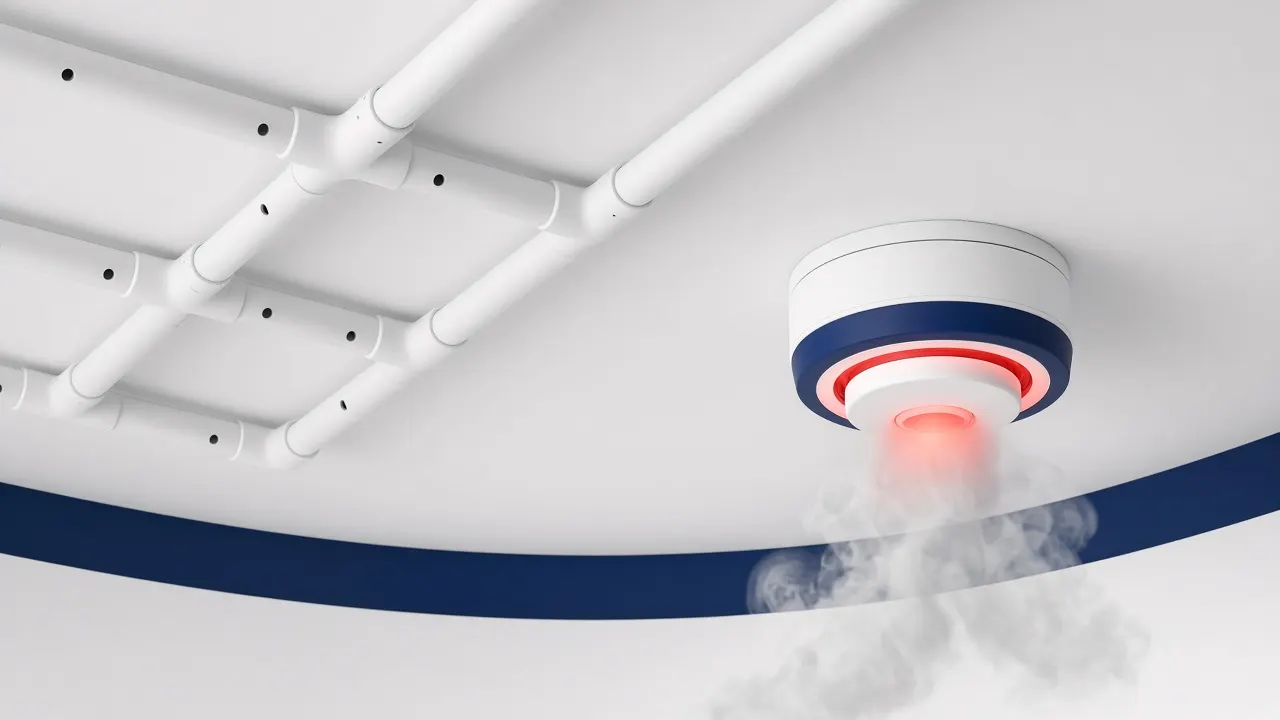
A fire detection system is a life-safety system, so it is subject to standards, Fire and Rescue requirements and business licence conditions. Within that framework the technology has developed considerably, from simple conventional detectors to addressable systems, highly sensitive aspirating detectors and wireless solutions.
Addressable systems
In a conventional system the panel only knows which "zone" (circuit) a detector activated in. In an addressable system each detector has an address, and the panel knows exactly which device activated, how dirty it is and whether there is a fault. Benefits: fast location of the event, preventive maintenance, fewer false alarms and precise control of associated actions such as door release, smoke extraction or notifying the monitoring centre.
Aspirating smoke detection (ASD)
Aspirating systems draw air through a pipe network with sampling holes and analyse it in a very sensitive central unit. They can detect smoke at a very early stage, before a point detector would respond. They are suited to server and communications rooms, high-bay warehouses, spaces with strong airflow, places that are hard to access for maintenance and buildings where detectors should be concealed. In European standards they are covered by EN 54-20.
Wireless detectors
Wireless fire detection systems complying with EN 54-25 suit listed buildings, temporary extensions and places where running cables is difficult. They communicate over a redundant radio network and report battery and faults. Check with the Israeli standard requirements and the approving authority whether they are accepted in the specific project.
Multi-sensor detectors
Detectors that combine optical smoke, heat and sometimes CO sensors can better distinguish a real fire from dust or steam, reducing false alarms in kitchens, warehouses and work sites.
What is new in Israeli standards
SI 1220 part 3 is the Israeli standard for fire detection and alarm systems. An amendment sheet published in January 2024 added, among other things, requirements for detectors in electrical panels above a certain size (according to publications: 63A three-phase and above, and 200A and above DC). In parallel, the Fire and Rescue uniform specification for business licensing determines when a detection system is required by type and size of business. Requirements change, so the current edition should be checked with a fire safety consultant and the approving authority.
Maintenance: the part you cannot skip
- Periodic tests according to the standard, recorded in a log book.
- Cleaning and replacing detectors according to manufacturer instructions.
- Checking battery backup and communication to the monitoring centre.
- Testing associated actions (doors, lifts, smoke extraction) against the design.
- Updating the system after changes to partitions or use of space.
Detector types compared
- Optical smoke detector: suits most spaces, sensitive to smouldering, smoky fires.
- Heat detector: suits dusty or steamy places (kitchens, car parks), but responds later.
- Multi-sensor detector: combines several sensors to improve discrimination.
- Beam detector: for tall, wide spaces such as halls.
- Aspirating system: for very early detection and special spaces.
Example: a server room
In a server room, airflow from air-conditioning disperses smoke, and a ceiling point detector may respond late. An aspirating system with sampling points near the racks' air outlets can detect an overheating component early, giving time to act before damage occurs. It is often combined with a dedicated suppression system, according to a consultant's design.
Example: a high-bay warehouse
In a warehouse with a high ceiling, smoke cools and spreads before reaching the ceiling. Beam detectors or an aspirating system with pipes at different heights are considered here, according to the standard and the design.
A typical project process
- Design by a fire safety designer or consultant, to SI 1220 and licensing requirements.
- Installation to the design, including fire-resistant cabling where required.
- Acceptance testing and documentation.
- Connection to the monitoring centre and associated actions.
- Maintenance and periodic tests recorded in a log book.
Associated actions: what is connected to the system
A fire detection system is not just sounders. Depending on the design, it can trigger or shut down other systems: release doors on escape routes, return lifts to the ground floor, stop air-conditioning so smoke is not spread, activate smoke extraction and notify the monitoring centre. Each link must be tested at acceptance and in periodic tests, because a change in another system, such as replacing the HVAC controller, can break it without anyone noticing.
Building changes
Renovation, new partitions, lowered ceilings or a change of use affect detector coverage. After any such change, check whether the design and system need updating, and document it. This is one of the most common causes of gaps found in inspections.
Dust and paint during works
During construction or painting, dust can trigger or contaminate detectors. It is common to cover detectors temporarily under an orderly procedure, and to make sure the covers are removed when work ends.
Monitoring-centre connection and responders
A fire detection system can report to a monitoring centre, which passes the alert to the responsible person and emergency services according to procedure. Again, check communication paths, power backup and the contact list, and update them when people change roles. Periodic reporting tests make sure the alert actually reaches its destination.
Summary
Today's detection technologies allow earlier and more accurate detection. The choice between them should be based on building type, risk and regulatory requirements, backed by an approved design and ongoing maintenance.
Want to check what fits your site?
Leave your details and we will get back to you to arrange a survey and quote.
Sources
- Standards Institution of Israel – SI 1220 part 3
- Israel Fire and Rescue – uniform specification, chapter 3.2 (Hebrew)
- CEN – EN 54 series (Fire detection and fire alarm systems)
Articles provide general information only and are not legal, engineering or safety advice. Regulatory requirements change; check the current text with the competent authority.
Related articles
What changed in Israeli regulation 2023–2026: cameras, fire, armories and communications
A consolidated overview of the main changes affecting low-voltage systems in the last three years, with sources and a clear note of what is still uncertain.
November 2026 · 5 min read
Checklist for a low-voltage service and maintenance contract
What must be written in a service contract for cameras, alarms, access control and fire detection, so service works on the day you really need it.
November 2026 · 5 min read
System convergence: PSIM, smart buildings and one control room for everything
Cameras, alarms, access control, fire detection and building systems: how to bring everything into one picture, and what to watch out for.
November 2026 · 4 min read