
AI video analytics: what actually works in the field in 2026
From person and vehicle detection to free-text search: what smart cameras can do today, where they still fail, and how to plan a project that gets real value from them.
November 2026 · 5 min read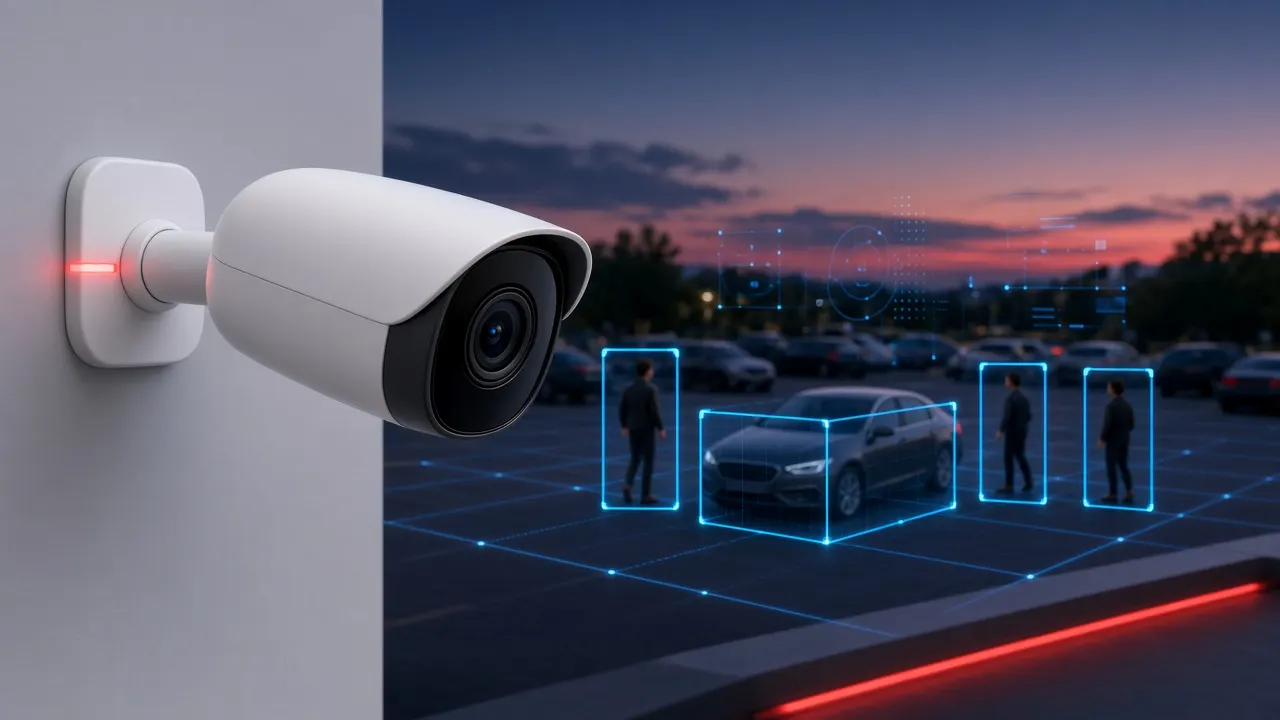
Ten years ago, "analytics" in security cameras mostly meant motion detection: pixels changing in the image. The familiar result was dozens of false alarms at night caused by leaves, shadows, rain or a passing cat. In recent years this has changed fundamentally. Deep neural networks, dedicated chips inside the camera and efficient encoders have turned smart analysis from an expensive add-on into an almost standard part of professional IP cameras.
What changed: intelligence moved to the edge
The main trend is edge AI: processing inside the camera itself, not only on a central server. A camera with a dedicated processor (NPU) can classify objects such as people, cars and motorcycles, and send only events and metadata to the management system. The benefits are clear: less load on the network and servers, faster response, and continued operation even when the link to the central server is lost.
Alongside the edge, analytics servers and cloud systems handle heavier analysis: retrospective search across large amounts of video, cross-site comparison and management reports. In most modern projects the answer is a combination: first-pass filtering at the edge, deeper analysis at the centre.
Common capabilities today
- Person/vehicle filtering for perimeter alerts, which significantly reduces false alarms compared with simple motion detection.
- Line crossing and intrusion into a defined zone, including direction and active hours.
- Smart search in recordings by attributes: clothing colour, vehicle type, direction, time.
- People counting, queue measurement and heat maps, especially useful for retail chains.
- Licence plate recognition (LPR) in car parks and at gates.
- Detection of left or removed objects, loitering and crowding.
The newest area is free-text search: models that link text and images let you search recordings with phrases like "a person with a red backpack near the rear entrance". Major manufacturers and VMS developers are showing such features, but performance depends heavily on image quality, angle and data volume.
Where analytics still fails
Realistic expectations matter. Good analytics starts with a good image: a camera mounted too high, at a sharp angle into the sun or in poor lighting will produce weak results, however advanced the algorithm. Extreme weather, reflections in glass and dense crowds also reduce accuracy.
Another issue is calibration: every site is different. Virtual lines, exclusion zones, sensitivity and minimum object size must be configured for the specific area and checked after installation and over several weeks. Projects where analytics is simply switched on with default settings and forgotten tend to disappoint.
Privacy and regulation
Advanced analytics increases the amount of data collected and the ability to identify people, so it touches directly on privacy law. In Israel, Amendment 13 to the Protection of Privacy Law came into force in August 2025, and the Privacy Protection Authority updated its guidance on cameras in public spaces and in the workplace in May 2025. In Europe, the AI Act restricts certain uses of remote biometric identification.
In practice: before enabling face recognition or employee monitoring, review purpose, proportionality, signage, retention period and viewing permissions, and consult a legal adviser where needed.
How to plan a successful analytics project
- Define the problem first: fewer false alarms? faster incident search? operational data for the store?
- Choose cameras for the scenario (resolution, lens, IR illumination and angle), not just for a feature list.
- Check compatibility between cameras and the recording and management system (for example through ONVIF profiles and dedicated integration).
- Run a pilot at a representative site before a wide rollout.
- Decide who receives alerts, how and when; otherwise even accurate alerts get ignored.
- Include maintenance of analytics settings in the service contract, not just of the hardware.
Example: a car park perimeter
Imagine a warehouse with an open car park and a fence a few hundred metres long. With the old approach, motion detection in the cameras would trigger an alert for every branch moving in the wind, and the operator would stop paying attention within the first week. With classification, you draw a virtual line along the fence, trigger the alert only for a "person" crossing from outside in, and limit it to the hours when the warehouse is closed. The expected result is few alerts, most of them relevant, each with a short video clip for verification.
Example: finding an incident in a retail chain
A branch reports a theft discovered two days later. Without smart search, someone has to watch hours of video. With attribute search you can filter for "a person in a dark shirt near a particular shelf between certain hours" and get a short list of clips. In a chain with dozens of branches, the time saved in investigations adds up quickly.
Edge versus server analytics: a comparison
- Edge: no extra server and low network load, but limited to the capabilities of the camera model.
- Server: more flexibility and heavier algorithms, but needs hardware, licensing and maintenance.
- Cloud: convenient for multi-site management, but depends on upload bandwidth and data retention policy.
Metrics to track after go-live
- Number of alerts per day and the share that are genuine.
- Average time from event to an operator viewing it.
- Time to locate a clip during an investigation.
Measuring these in the first weeks lets you tune settings and demonstrate value.
The bottom line
AI analytics is no longer a future promise; it is a working tool that can save a lot of time in incident investigation and make a monitoring centre more efficient. The value comes from combining correct camera placement, professional calibration, a clear privacy policy and ongoing maintenance. That is exactly the difference between a system that is "smart" on paper and one that works.
Want to check what fits your site?
Leave your details and we will get back to you to arrange a survey and quote.
Sources
- Israel Privacy Protection Authority – surveillance camera guidelines (Hebrew)
- Israel Privacy Protection Authority – Amendment 13 guide (Hebrew)
- ONVIF – Profiles
- EU AI Act – Regulation (EU) 2024/1689
Articles provide general information only and are not legal, engineering or safety advice. Regulatory requirements change; check the current text with the competent authority.
Related articles

Cloud video (VSaaS) and hybrid VMS: when it makes sense for a business or chain
Manage cameras from anywhere, automatic updates and a monthly fee, alongside questions of bandwidth, data retention and security. A decision guide.
November 2026 · 5 min read
4K, colour night vision and thermal: choosing a camera for the scenario
More megapixels do not always mean a better picture. What really matters: sensor, lens, dynamic range, lighting and compression.
November 2026 · 4 min read
IP camera cyber security: Israeli warnings, US restrictions and what to do in practice
A camera is a small networked computer. A factual look at Israel National Cyber Directorate warnings, FCC and NDAA restrictions on certain manufacturers, and practical hardening steps.
November 2026 · 5 min read